Home » How to Guide » Trouble Shooting
Kurapia Isn’t Growing
Symptom
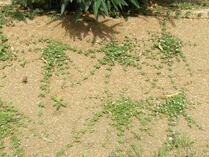
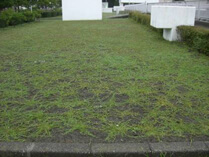
Instead of growing evenly over the entire space, the runners’ growth is shaped like starfish. Anthocyanin* is present even in warm weather and causes the leaves to turn purple. *Anthocyanin is a water-soluble pigmentation that causes fruits and flowers to look red, blue, or purple.
Cause
Lack of fertilization in the soil.
Solution
Addition of fertilizer. Fertilizer does not hold well in sandy soil such as decomposed granite. Addition of 100 day slow release fertilizer is recommended.
Dried Up
Symptom
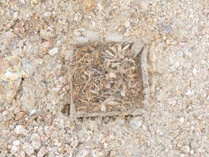
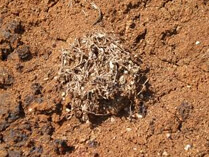
The plant dried up entirely.
Cause
Not enough water, shallow planting of the seedling.
Solution
Water regularly after planting until the Kurapia takes root. Shallow planting results in gaps between the roots and the soil, so plant the Kurapia deeper and provide plenty of water. Once the Kurapia takes root, do not water unless it is used in green-roofing or planted in sandy soil. Watering over long periods of time will result in the roots becoming damaged or diseased.
Kurapia is too tall
Symptom
Overgrowth of Kurapia
Cause
Too much water, too much fertilizer
Remedy
Mow the Kurapia. After mowing, use water sparingly, and do not water too frequently.
Other
When planted, Kurapia’s roots will first start to grow. During this time, the stem and leaves will not grow. After the roots have grown, the stem and leaves will start to grow. If it has been one month since planting (with an average temperature of 55.4 degrees Fahrenheit) and the stem and leaves don’t grow and cover ground, then there is most likely a problem and mitigating measures must be taken.